


Dr. John Z Kiss
Melbourne, FL
PROGRAMS:


COMPANIES:
POSITIONS:
NASA & ESA Space Biologist
L3 Harris Professor & Provost, Florida Institute of Technology
COMMENTS:
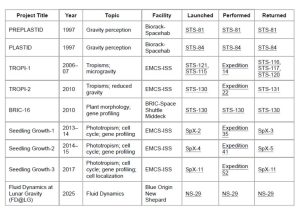
These are space missions for which Dr. John Z. Kiss served as Principal Investigator.
John Z. Kiss is Provost and Senior Vice President for Academic Affairs at Florida Institute of Technology, where he also serves as the L3Harris Distinguished Professor in the Department of Biomedical Engineering and Science. An internationally-recognized space biologist, accomplished academic leader, and advocate for STEM education, Kiss has built a distinguished career spanning spaceflight research, teaching, administration, and public engagement. He currently oversees Florida Tech’s academic enterprise, including more than 430 faculty members, multiple colleges and academic support units, over 180 academic programs, and approximately 10,000 students.
Kiss earned a Bachelor of Science degree in Biology from Georgetown University and a Ph.D. in Botany and Plant Physiology from Rutgers University. His academic career includes faculty and leadership appointments at Hofstra University, Miami University, the University of Mississippi, the University of North Carolina at Greensboro, and Florida Tech. Prior to joining Florida Tech in 2024, he served as Dean of the College of Arts and Sciences at UNC Greensboro, where he led one of the university’s largest academic units. Earlier, he served as Dean of the Graduate School and Interim Senior International Officer at the University of Mississippi, providing leadership in graduate education, international programs, faculty advancement, and strategic planning.
Internationally, Kiss is best known for his pioneering contributions to plant space biology. Since the late 1980s, he has investigated how plants perceive and respond to gravity and light, research that has fundamentally advanced understanding of plant growth and development in space. He has served as Principal Investigator on nine spaceflight experiments conducted aboard the Space Shuttle, the Russian Mir space station, the International Space Station, and Blue Origin’s New Shepard rocket. Many of these projects were collaborative efforts involving NASA and international partners from the European Space Agency (ESA), Japan Aerospace Exploration Agency (JAXA), German Aerospace Center (DLR), and other leading space organizations
Among his most notable scientific achievements was the discovery of a novel red-light sensing mechanism in plants, a breakthrough enabled by the unique conditions of microgravity aboard the International Space Station. He also conducted some of the first experiments examining plant responses to fractional gravity levels similar to those found on the Moon and Mars. These studies have helped establish a scientific foundation for future human exploration missions by demonstrating how plants may be used in bioregenerative life-support systems to provide food, oxygen, and environmental sustainability beyond Earth.
Kiss has published more than 130 peer-reviewed scientific papers, secured over $11 million in externally funded research support, and accumulated more than 7,600 citations with an h-index exceeding 50. His publications span plant physiology, developmental biology, space biology, astrobiology, and gravitational research, and his work has appeared in leading journals including Plant Physiology, Planta, New Phytologist, American Journal of Botany, and npj Microgravity
In addition to his research accomplishments, Kiss has played a major leadership role within the international scientific community. He has served as Chair and Vice Chair of life science commissions within the Committee on Space Research (COSPAR), President of the American Society for Gravitational and Space Research, editor or associate editor for numerous scholarly journals, and organizer of major scientific conferences across North America, Europe, and Asia. His efforts have strengthened international collaboration in space research and fostered partnerships among universities, government agencies, and research institutions worldwide.
His many honors include NASA’s Outstanding Public Leadership Medal, the Founder’s Award from the American Society for Gravitational and Space Research, the Benjamin Harrison Medallion from Miami University, multiple NASA Group Achievement Awards, and the COSPAR International Cooperation Medal, one of the highest distinctions in international space science. In recognition of his scientific contributions, the International Astronomical Union named asteroid 8267 Kiss in his honor.
An accomplished mentor, educator, and communicator, Kiss has supervised dozens of undergraduate researchers, graduate students, and postdoctoral scholars, many of whom have gone on to successful careers in academia, government, and industry. He has delivered more than 100 invited presentations around the world and has shared the excitement of space biology through podcasts, public lectures, and a widely viewed TEDx talk titled One Day We Will Live on Mars. Through his leadership and scholarship, John Z. Kiss has made lasting contributions to higher education, plant science, and humanity’s quest to explore and inhabit new worlds.